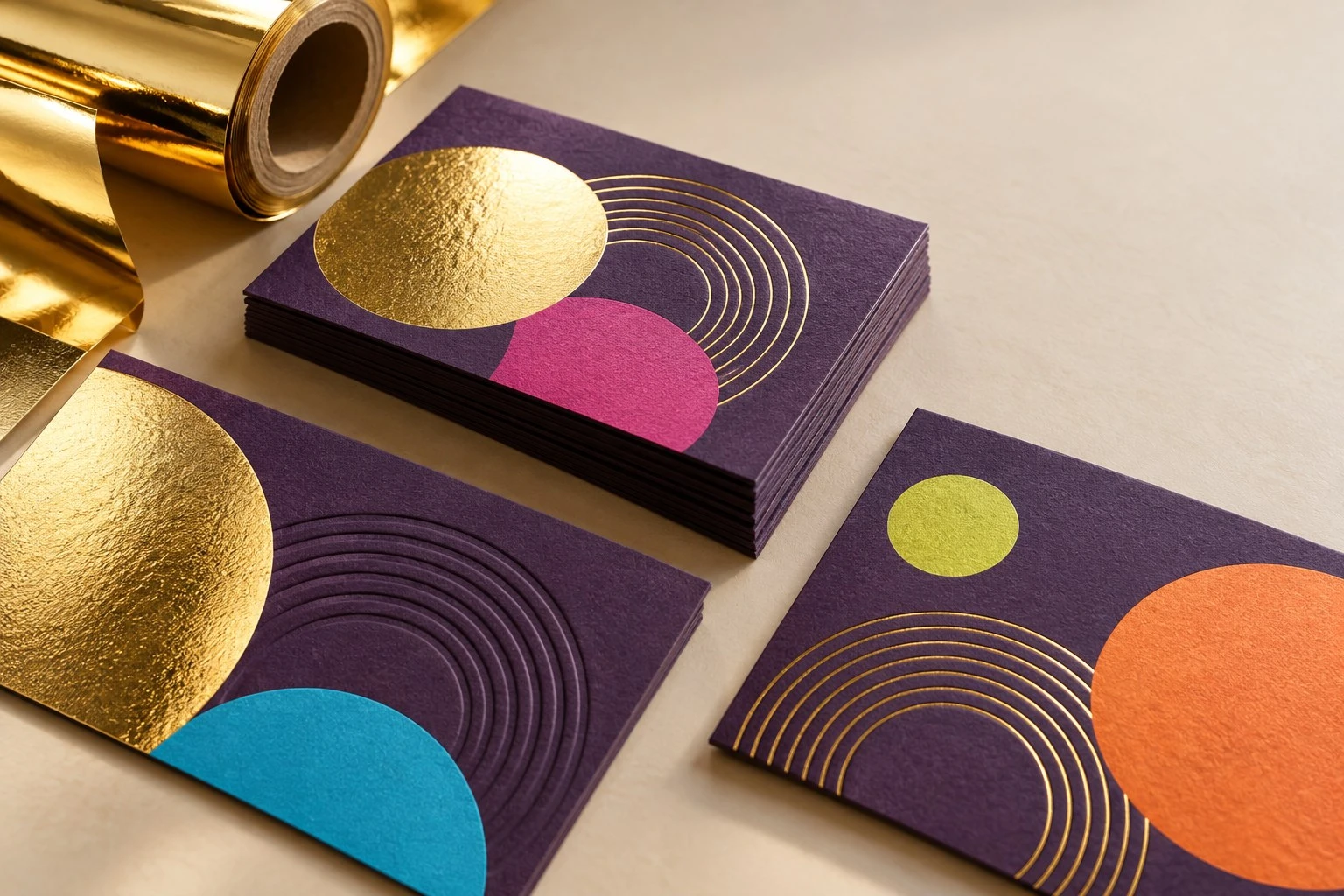
 Foil stamping - what is it?
Embossing is a technique , which has been used in printing since its inception. Moreover, it is the prints of various forms and meanings that are the primary source for the invention of printing presses. After all, back in 1370, folk craftsmen, having improved the meaning of wax seals, adapted themselves to using wooden stamps to form a certain pattern on clay, leather or other products. The process was simple - a relief image was made on one strong surface for transfer, and then the mold was imprinted on the desired product by mechanical force. Developing, this type of stamping became the promise for the discovery of the printing press, which gave mankind the advantages and conveniences of printing production.
Over time, publishing machines became better and better, and they began to use rolling rollers and ink instead of impact machines for transfer (offset printing). The printed word became "popular", allowing millions of manuscripts to be preserved for centuries and made public. And with the phenomenal discovery of polymer components and the development of the science of polymerization, printing turned out to be so accessible that leaflets, posters and other printing appeared, without which it is difficult to imagine a civilized business world. And here the formation of "chased" prints found a second birth. After all, using molds and metallized polymers, it was possible to give paper media a zest - to make them unique and personalized. Glitter and metallic suspension trims were made for reprinting monograms on books. Moreover, not everyone could afford such “artsy” presentations. Therefore, the logos and text elements molded in silver and gold surprised and inspired respect, demonstrating the status of their owner.
The displaced and shiny patterns on modern business cards have approximately the same effect, indicating the prominence of their owner. Therefore, relief has not lost its relevance today, becoming a favorite tool for printers to produce luxury products. And although today everyone can afford the production of unified printing, a foil business card still helps to stand out and demonstrate the seriousness of one's intentions. Therefore, most often they are ordered by directors of large firms, heads of various levels and people of creative professions.
What are the prints?
at the beginning of its development, the methodology for giving relief was not much different from setting seals on sealing wax. The edges were heated and then pressed into the paper (rarely leather) base with force. At the same time, a thin layer of composition with metal dust was applied on the plate before the print to obtain an iridescent relief. This species was called "hot". However, with the invention of polymerization, options for printing without heating opened up for printers, and in the production of brochures, lamination with films with a metal component began to be introduced. However, according to the principle of operation, they are all divided into 3 categories:- Foiling. In the process of this post-processing, a slightly in-depth picture (relative to the surface of the paper) is obtained, silver or gilded on the inside. The most common type of personalization, which allows you to get fairly clear stamps with smooth edges.
- Blind or blind. This post-processing is sometimes called "extrusion inside". By means of a mechanical or pneumatic press, the layout is deeply deepened into cardboard. Most often, in this way, leather and plastic are processed, less often cardboard. And although this variation is almost never used on the domestic print market, in other countries it is often combined with foil, resulting in an iridescent or holographic inner edge. on the front side). The stamping cliché has 2 forms - a matrix and a counter matrix, allowing you to create convex pictures or even carry out double-sided deformation. It is rarely used for forming cardboard, but has found its use in the formation of plastics (for example, in creating raised bank card numbers).
All transfers, regardless of the density of the base, require a certain mold (cliche). The cost of developing such a "matrix" is high (compared to the price of printing), so the release of piece orders is not economically justified. Regardless of the type of processing (pressing, reprinting), it is advisable to produce from 100 to 500 units of business cards or cubes. For large runs, it may be necessary to replace a worn mold, otherwise there is a high chance of quality loss.
Hot stamping technology
Hot forming is one of the first options application of holographic patterns, which appeared in the days of lack of experience with two-component adhesives. The secret of the processing lies in the use of a unique thermal transfer foil. It is not homogeneous in its texture, and consists of the smallest metallized particles, fixed by means of adhesion on the substrate.
This composition is placed between the mold and the desired surface. After that, the cliche heats up and extrudes. The foil is melted along the contours, and fixed on the inner plane by gluing.
Today, there is a wide variety of embossing foils - from traditional gold and silver “sputtering”, to multi-colored (and even matte) films.
The advantages of heat treatment are good speed, as well as sharp edges the resulting image and its almost perfect fixation. However, due to high temperatures, the processing of plastics and other PVC components with a heated press is not possible.
Our printing house performs foil stamping on specialized equipment PT2T, which is the best in this field. Thanks to this, we perform foil stamping of any complexity. You can watch a video of our work on our official facebook and youtube pages (links at the bottom of the site).
Cold foiling technology
Cold typographic "spraying" was invented much later, and gained popularity in the modern era of perfection of mechanized machine tools. It still has the same principle of prepared foil carriers, which are fixed with glue on the original plane. However, unlike pressing when heated, materials for cold "chasing" do not contain an adhesive layer. It is applied to paper or PVC separately, by means of silk-screen printing or pressing. After that, it remains only to press the foil tape to the product, and start polymerization under UV radiation. In places where there was no glue, the tape "disappears", and where the adhesive composition was applied, it sticks to the surface.
This personalization is more productive than analogues, and allows you to process almost any "plate" - paper, plastic, leather. At the same time, the procedure can be mechanized and optimized, making it possible to produce circulations of a thousand copies or more. However, from an economic point of view, the optimum methodology also lies in the range of 200-500 copies.
“Chasing” makes small descents more accessible - using template typesetting “heads”, you can produce piece-by-piece production. However, the accuracy is lower than in thermoforming (due to the use of an intermediate stage of applying the adhesive layer). That is why both pressings develop in parallel, without competing with each other.