 Printing on cups, painting on mugs
10 more -15 years ago, personalized or stylized kitchen utensils could only be seen in large luxury hotels and business facilities of huge corporations. In those organizations that could afford to make large wholesale orders from 100 thousand pieces. Today, a cup with a name has become a familiar souvenir that can be found on the shelf of any themed store. But the name or zodiac sign is not all that can be found on the dishes. Indeed, today's printing technologies on dishes and kitchen utensils allow you to transfer almost any image - from various humorous quotes to your own photographs.
At the same time, circulations start from 1 pc. while the price is available to absolutely everyone. How and what has changed? What made it possible to achieve such results?
Today, 3 main technologies are used to style mugs:
- Decal
- Transfer;
- Sublimation
- Silkscreen
Each of them has its own advantages and disadvantages, so most manufacturers of souvenirs are ready to offer one of the ways to transfer an image to choose from, satisfying certain technological tasks.
Hot and Cold Decals
The oldest method of fixing pictures on ceramics is decalcomanie (French for "translation"). It was invented back in the era of the emergence of industrial methods for the production of dishes. The principle of such a transfer is quite simple - the original “layout” is reprinted on the “substrate” with special paints, and varnished on top. Then the image is "translated" to the desired plane. And the varnish acts as a link that binds and holds the ink.
At this stage, the cold “print” process is completed and the molding is ready for use. However, the picture on it, which has not undergone additional processing, cannot boast of durability and reliable fixation. And although this transfer method is faster and cheaper than all the others, it is mainly used to create a decor that will never see a sink.
If you need to get a more resistant painted surface, a firing procedure is applied to the decaled materials. Ceramics are "dryed" in a high-pressure ceramic kiln. As a result, dyes thoroughly penetrate the material and are securely fixed on it. Such products can be safely washed and used in everyday life - its surface will be homogeneous, resistant to mechanical abrasion and fading.
However, the disadvantage of decalcomanie "hot" is the duration of the process, the need for its quality control and the technological difficulty of implementation. In view of this, the product leaving the firing chamber is more expensive. In addition, the production of small batches (up to 100 pieces) is not economically feasible.
Both cold and thermal "translation" lose to all others in color and richness of shades. After all, special paints are used to implement them, and a full filling of the available area will inevitably lead to the fact that the pattern will “float”. Its principle completely inherits its predecessor and consists in:
- color rendering;
- sticker;
- firing.
However, this methodology uses modern laser printers that are not limited in color rendering capabilities. The secret lies in the paints - they contain an organic and inorganic component. The first burns out upon exposure and ensures the heating of the polymer and its adhesion to the base.
Products obtained using the transfer technology are bright, colorful and not limited in quantity (it is advisable to fulfill even single orders). However, the coloring compositions do not penetrate deep enough to guarantee the resistance of the print to mechanical wear. And in the process of daily use, over time, the product is scratched and loses its aesthetic appearance.
Sublimation
The principles of sublimation is a cross between the old methods of “burning in” and applying to special paper. The print is also re-glued onto the material and fired in the press. But now the coloring compositions have a low burnout point, and at high temperatures turn into a gas. And the pressure "drives" these substances deep into the plane of kitchen paraphernalia.
Thus, it turns out well-colored, wear-resistant and fading-resistant products made in modern color rendering standards.
The advantages of this printing method:
- It is possible to produce a circulation of 1 piece. at an affordable price
- Very colorful color rendering
- Resistant coating that is not afraid of the dishwasher.
- Prompt production time from 1 day.
Cons of this printing method:
- There must be special cups that are covered with a special transparent varnish.
- Unable to print in pantones
- Slight color differences may occur.
Types of cups for printing
The quality of the print that will be imprinted on the mug depends not only on the procedure for printing it. Of great importance is the base / workpiece itself, the experience of workers and the equipment on which the process takes place. Most often, such “glasses” are used to implement such projects:
- White. The most standard option, which will look equally beautiful on a logo, a photo, and textual information. For souvenirs and gifts - just what the doctor ordered.
- Colored. Yellow, red, green. Even gold and silver with mother-of-pearl make it even easier to stand out and surprise.
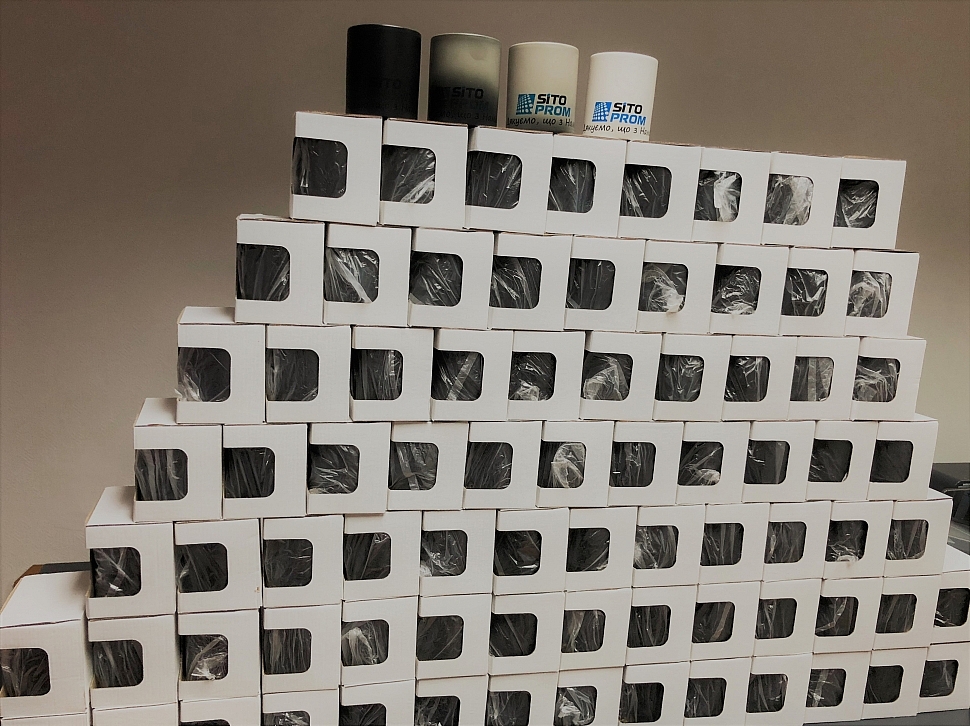
- Chameleon. Popular trend recent years. The surface of such a product is black, but under the influence of the temperature regime (warm liquid is poured into the glass), its outer side becomes white, revealing the previously hidden pattern. The best solution for a gift that will surprise and delight your loved ones.
Depending on the chosen base, the possibilities of color and dimension of the image may differ, as well as other details of the picture - brightness, saturation. But thanks to a professional approach, we have developed special profiles that allow you to get the print on the cup as similar as possible to the layout.
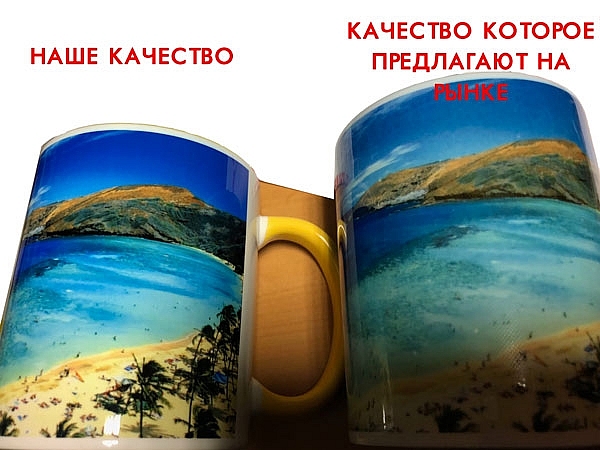
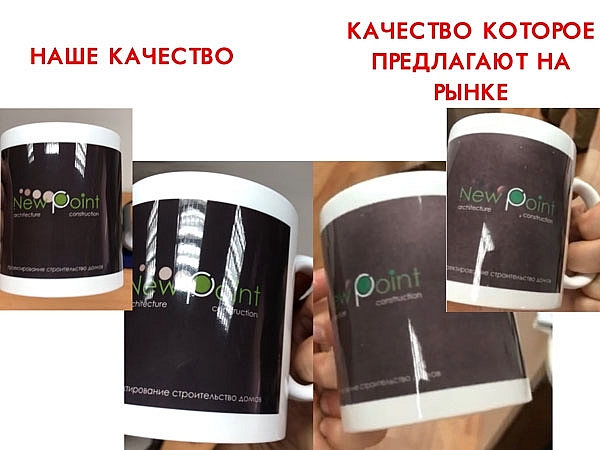
At the moment, there are a lot of quality standards for cups on the blank market: Standard, Standard +, Class A, Premium. Our printing house uses exclusively premium types of blanks, which minimizes the presence of dots, craters, depressions, peeling of the varnish coating, etc.
On these examples you can see the differences between printing by our specialists and the printing that our regular customers received from previous contractors.