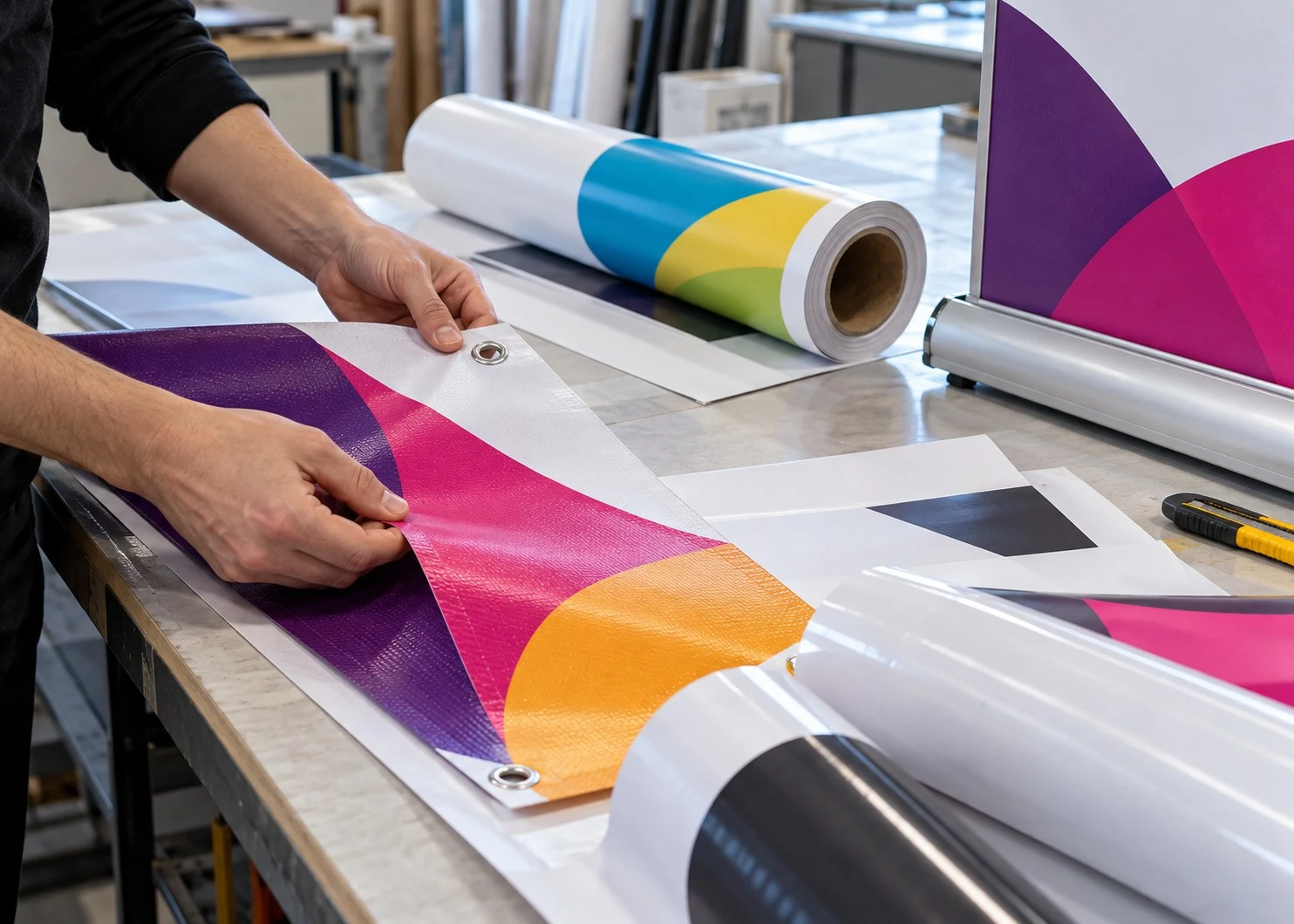
 What is large format printing
In response to the growing demand for printed products, printing facilities have evolved, increasing the pace of work and their own size. And when polymer fabrics and ink came into use, a completely new scope opened up before the printing industry - the need for large-format installations. Indeed, before that, the maximum dimension of printed products was limited to a roll of paper (150 centimeters), and the only carrier was the products of the pulp industry. They rarely withstood prolonged use and did not tolerate an open atmosphere (not to mention the limited color and separation ability).
Therefore, as soon as inkjet technology appeared and digital printers became available, wide format machines appeared almost immediately. Today, this term is mainly used for the production of promotional items, but the technology is used in all spheres of life - from packaging development to textile production and even the automotive industry.
Peculiarities of large-format printing
Everyone who at least once had a chance to observe the filling of a film or a banner noted a certain similarity of this process with the use of an office printer. After all, they are based on the same principle of using a computer-driven “head”, which sequentially spills the material row by row with ink.
However, a printing machine differs from a conventional printer:
- Dimensions. The smallest units can accommodate rolls over 100 cm wide with no length restrictions. At the same time, it will not be difficult to find devices that can fit even a 5-meter bundle.
- Accuracy. Working with rolls, the machine ensures the accurate execution of dimensional projects. For example, when making a banner with a length of 10 meters or more, the divergence of the end points will be no more than 3-5 mm.
- Number of cycles. In an ordinary office machine, you can find a “head” that makes a certain number of passes (most often 1). In large-sized equipment, there can be 10, 20 or more “flowing” organs, and the number of their passages is set by the operator. This allows you to grade the product into categories - "economy", "medium", "photo quality".
The principle of transfer involves the use of pixel technology and point transfer. Moreover, the higher the quality, the denser the dots will form and the base filling will be richer (unlike photographic machines that apply colors in several layers).
In addition, the main difference of such equipment is the ability to use special ink - solvent , latex, UV and oil paints. This allows you to process different work surfaces and make the image resistant to moisture and other factors.
Settings for polymer consumables, “they are also “full color”, inherited the ink mixing procedure from printing and improved it. Therefore, with its help, you can achieve excellent brilliance and accuracy of transmission even of images taken with professional photographic equipment.
Types of widescreen
In modern production, design and advertising, “full color” can be divided into 3 categories:
- Interior. As the name implies, the product will become part of the interior - a stand, a poster, photo wallpapers. And they will look at it from a close distance. Therefore, the main feature of this subspecies is high quality, the use of special dyes (non-toxic, without a pungent odor). However, the durability of eco-inks leaves much to be desired - they quickly wear out and do not last long in the open air.
- Outdoor. The main profile of advertisers. Such products hang on poles, billboards, walls and signs and are viewed from a distance of at least 3 meters. dyes are somewhat toxic, but highly resistant to weathering.
- UV. A recent discovery that has given printing possibilities white on transparent plastic, as well as UV resistant images.
The end user, on the other hand, differentiates widescreen by the products they produce:
- Banner. The most budgetary option for advertising or presenting information. PVC fiber polymer fabric (reminiscent of a tarpaulin) is found on banners, signs, posters, billboards.
- Self-adhesive film. With its help, showcases, cars are branded, stands, plates, and decor are made.
- Light-scattering paper. It is used in city-lights and light structures as a temporary information carrier.
- Blue-Back. Cellulose fabric with synthetic layer for temporary advertising. Most often it can be found on billboards and promotional planes. Most often, it does not withstand long service life and is designed to operate for several weeks.
However, with the advent of latex ink, printing on solid media - plastic, acrylic, glass - also came into use. Such a procedure is called “direct output” and is not widely used.
Printing room equipment
Special units are used to transfer images to PVC bases. However, the technological equipment of the production shop does not end there.
Conventionally, the whole process can be divided into stages, each of which is responsible for its own group of devices:
- Prepress. In addition to a computer, a designer monitor and templates, you need a printer designer, and a software package for preparing files for output.
- Application. A printing machine is involved in pouring inks. But in addition to it, you need hoods to eliminate odors, dryers for fixing, CISS and heating systems, climate technology to maintain optimal operating parameters.
- Post-print processing. Depending on the order, you will need dryers, guillotines, eyelet presses, systems for soldering banners, a set of measuring accessories.
In addition, you will also need a set of equipment for diagnostics, adjustment, repair and maintenance.
Advantages and disadvantages
The advantages of full color are numerous. Although it would be more correct to call them pluses, because this method simply has no alternatives.
Firstly, these are the dimensions and variety of materials. From flags on a stick to outdoor flags, from films to glass and plywood, you can ink everything.
Secondly - resistance to precipitation. So, apart from temporary advertising, most of the products offered by such a printing house easily "survive" bad weather, moisture and elevated temperatures.
And, finally, availability. The modern wide format allows you to replace even printing, produce stickers on glasses, safety signs and "nameplates" cheaper and faster.
With all this, the only drawbacks are the fading of colors (in the case of UV ink, high cost and time), as well as the need to assemble materials. Because of this, it is economically unprofitable to make piece and small orders in a short time. Estimated service life of banners on the street is 2-3 years, depending on the place of installation and the quality of fastening.