 What is risography?
Sometime with the advent of the first In the printing industry, the process of transferring manuscripts to paper had only one option. But with the advent of various technologies and dyes, many alternatives have appeared, each of which has found its niche and found its purpose. Including the process called duplication or replication, better known as risography.
This type of printing received its name by analogy with “Copiers”. So, the first of the well-known manufacturers of "duplicators" was the company Riso. And the very procedure of its use reminded experienced polygraphers of silk-screen printing. The combined name of these words "took root" among printers and became a household name.
Products produced on such equipment are less common than business cards, flyers, booklets and other attributes of advertising agents familiar to everyone. However, it can be found in any office or body of the bureaucracy in the form of forms and templates. And the simplest example of such a seal is monochrome announcements on the entrances and the corresponding information boards.
In fact, Riso-graphy is the rapid production of cheap copies with low print quality, and standardization of products . Most often on low-density "office-type" media (while printing machines work with "chalk" or cardboard). Unlike more advanced printing principles, it does not require special skills and special workshops, and can easily fit in the office of a company.
The scope and advantages of the risograph
With the advent in the everyday life of devices like Xerox, digital duplication has “faded into the background”. Easier to use and refill, template "copiers" began to gradually replace duplication, which was somewhat limited in its capabilities. However, they could not completely “win back” their niche. After all, the risograph has undeniable advantages over digital and even offset variations:
- High speed. Modern devices are capable of producing about 185 A3 sheets per minute. It's faster than any modern printer or rolling machine.
- Affordable. With an experienced operator and the purchase of quality consumables, the disruptions and costs of producing small to medium runs are minimal. Already on the 50th printed form, the creation of a cliché pays for itself. And on medium slopes (from 50 to 5 thousand copies) it becomes more profitable than offset presses. Moreover, unlike the latter, the use of such a printout does not lose its relevance even with small descents.
- The possibility of using both white and color, or craft paper. At the same time, without losing the speed and quality of printing.
However, due to significant limitations in separating power and type of materials, the main area of technology is limited to “dispensers” of various formats. Most often, these are A4, A5 and A6 information-oriented booklets, in which only textual information is enough - advertising for window / door installers, information about an event, “reminders” to employees about upcoming important mass events.
Duplicators are excellent for producing promotional and informational leaflets with a low shelf life and a fast distribution rate. After all, with a low price, average quality and the benefits of releasing large batches, it makes no sense to carefully select the target audience of a marketing strategy. This is an ideal option for the production of "fliers" - short messages with a maximum scope.
However, this copying methodology is no less in demand in the work of budgetary structures and organizations with a large document flow. After all, it allows you to print forms, information sheets, applications or documents at minimal cost (4-8 times cheaper than on the most economical printer).
Printing technology
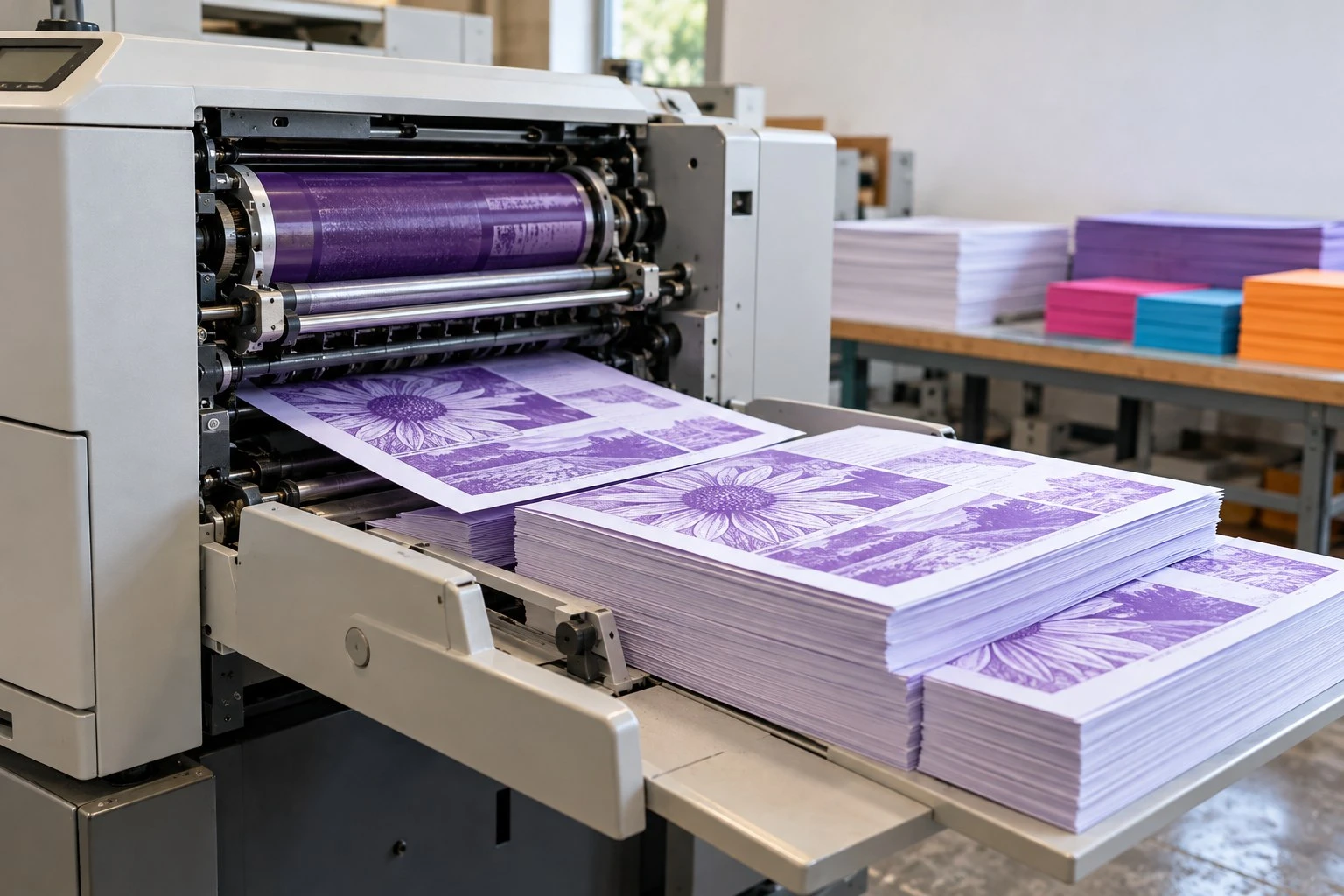
Risograph is a device that appeared at the junction of two generations of printing technology - copying and offset. It is based on the principle of using a rolling roller and ink supply. However, layout transfer works a little differently:
- Creates a snapshot. To get started, you need to place a document made in any way into the unit. Most often, for these purposes, a printout on a high-resolution digital printer is used. The new risographs already have an interface that allows you to start printing files from a computer, which significantly increases the image quality and speed of production.
- Creating a “press mold”. The scanned image is automatic of the unit digitizes, subsequently “burning out” holes in the corresponding places / points on a special polymer base. Thus, the electronic "brain" of the machine prepares the stencil through which the ink will be applied.
- Shaft preparation. By rolling, the prepared template wraps the image drum. Ink is fed into it, which is gradually forced out through the holes formed and prints the paper medium.
- Descent of circulation. Rotating and constantly supplying ink, the rolling roller makes an impression. It is similar to silk-screen printing or pad printing, only it is ten times more productive.
At the same time, almost all procedures, except for sample formation and paper loading, occur automatically. And at the output, the user receives a finished product that does not require additional processing - drying, polymerization.
However, this simplicity also hides the main limitations that this printing principle has. The main one is color. So, most Riso and similar techniques are able to work with only one dye, because. it is technically impossible to feed many colors into the drum. And although modern models of devices allow you to print in two colors at once, sequentially sealing the layout, replication is still a one-color process. Hence the need to use colored paper in order to create an additional attraction of attention.
The replication procedure also cannot provide two-sided printing of the base at the same time, which slightly complicates the operational production of two-sided leaflets. Between the printing of the front and back parts, it is advisable to withstand at least 15-30 minutes so that the paint dries better. Due to the fact that all paint for risograph is water-based, the resistance of such a product under the influence of an open atmosphere leaves much to be desired. Recently, a lot of companies, in order to save money, use non-original consumables. Because of this, the quality of not only printouts is lost, but there were also cases when low-quality ink affected the condition of the person to whom it got on the skin. Pay great attention to this, because saving a few cents, you can harm yourself in the first place. The first sign that the paint is not original is the price of the print run, the second is the pungent smell of your leaflets.
Trust only trusted companies and don't let yourself be deceived. Our risographs have never seen "non-original" ink in their lives!!! Ordering replication on a risograph is very easy and convenient without leaving home.