 Are print media relevant in the digital age technologies?
10 years ago it was difficult to imagine a functioning enterprise without business cards and leaflets. From an individual entrepreneur to a large corporation, any undertaking started with an order for printing products and handouts. And, despite the fact that today digital technologies and modern systems are replacing obsolete types of advertising everywhere, printing is still the stone that creates the foundation of a business being started. Having survived the change in trends and development, it not only has not lost its significance, but has become even more relevant. And today all "printers" note a stable growth in demand for stamped products. It was provoked by several factors at once:
- Price reduction. Greater competition, increased speed of printing equipment and the opening of new paper industries led to the fact that I can afford a stack of "name cards" everyone can do it - both individual entrepreneurs and individuals.
- Information overload. During the total filling of physical and media space with advertising materials, everyone tries to stand out. Someone orders dynamic stories on digital scoreboards, others rent boards. And among this motley, variegated and incomprehensible information "mess" only a business card and a leaflet continue to be an island of the familiar, understandable and accessible. That is why most business relationships begin precisely with the exchange of paper paraphernalia.
- Technological development. Strange as it may seem, the development of modern methods of transmitting and storing information has made people less tolerant and more lazy. So, according to recent studies, about 64% of the world's population do not write down the number of new business contacts simply because they do not want to spend time on it. Therefore, the establishment of communications, entirely falls on the paper shoulders of printed materials.
As a conclusion, it can be said with confidence that the trend of growth in demand for printing will continue to increase. And the process of obtaining contacts will soon switch entirely to the mutual exchange of personalized cards with all the necessary information.
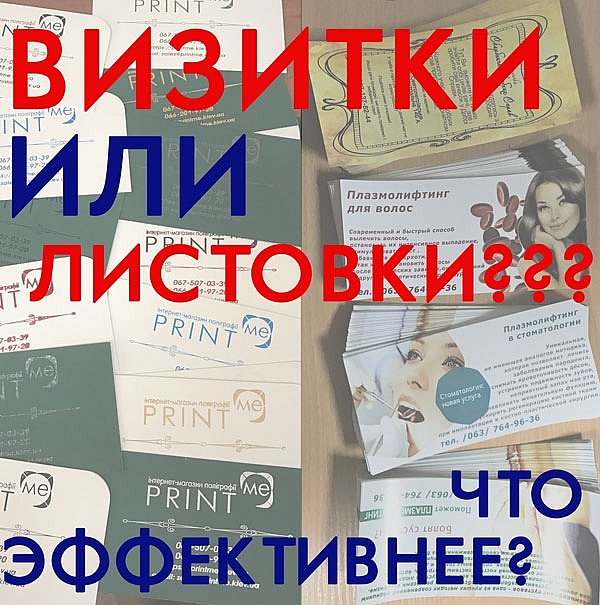
What is more effective than business cards or leaflets?
Calculating the budget of their "startup", many businessmen are wondering - which put the type of printing house in the estimate. Which is more efficient and will bring more significant benefits and commercial benefits?
Having a common origin and form, the two main business tools have fundamentally different mechanics of work. One serves to inform and acts immediately, attracting customers and allowing you to win a new audience. The other one has a more prolonged effect, and most often works after several months or even years (therefore, it is important to distribute it constantly).
If we compare the percentage of conversion (response of potential customers), then it will correlate in a proportion approximately equal to 30/70%, where a smaller share is for information leaflets. Therefore, if the relevance of making "cards" starts from 1000 copies, then the optimal circulation for flyers-leaflets are descents from 10,000 pieces.
The benefits of flyers
When starting their own business or planning to work on corporate identity, many active people wonder about the advantages of flyers over other typesetting services. From the first (and also the second) glance, everything is obvious here:
- More space. "Razdavayki" contain more usable area, so they can accommodate a lot of necessary information. In addition to phone numbers and addresses, this can be a map, an invitation to participate in promotions, information about discounts and sales. Starting from this size, it is important to use real photos of goods, interiors or services.
- Quick action. Unlike everything else, brochures are aimed at quick interaction with the target audience. This is the type of product that pays off from the first day of use, and the effect is noticeable immediately after use.
- Flexibility and targeting. Euroflyer and other types of "flysheets" can be easily adjusted to a specific promotion, target audience, territorial boundaries. There is no need to make a sheet template.
This type of advertising is an effective "amplifier", which can be both the main and auxiliary weapon of an advertising company. But it cannot replace all other communication products and methods. And most often this subspecies of “paper templates” still needs to be reinforced by advertising on the radio or billboards.
Do you need business cards?
Due to the fact that the smallest of the standard templates (5x9 cm ) is very limited in space, it cannot carry a really significant advertising load. Its purpose is to store details of corporate style and important data - from mail to address and mobile number. Therefore, if you treat such a product correctly, and do not try to save money by shifting a full-fledged booklet to a tiny font, then you will hardly be able to do without it in business.
Besides, there is no second chance to leave a first impression. Namely, it often becomes a bridge for long-term and mutually beneficial cooperation between the two parties. And in this regard, a business card is the very little thing, “without which there is no way.” It is she who will form the attitude towards the interlocutor, show the seriousness of his intentions and even set the tone for the conversation. Hence the need for a qualitative study of this attribute, and sufficient funding for its constant updating and updating.
What is more relevant?
Having fundamentally different mechanisms of work, typographic products are clearly directed. Therefore, it is necessary to analyze their relevance based on their destinations. So, when tasked with “promoting” a promotion, or making an announcement about an upcoming sale, there is nothing better than flyers. But on the other hand, if you need to complement your corporate image, build relationships and make new connections, you can't do without business cards .
In the right way of doing business, both promotion tools can and should be used in parallel. After all, any marketing strategy fully reveals itself only in a detailed study. And the more these details, and the better they are coordinated with each other, the more successful the action will be.